Inside Aurora: Anatomy of an Institutional Crypto Trade
In digital asset execution, the quoted spread is only a reference point. Execution quality is won or lost in the gap between quote and fill. Here’s where Aurora comes in.

Institutional digital asset execution now spans a growing network of centralised exchanges, decentralised venues, liquidity providers and trading protocols. For trading teams, the real challenge is not price discovery but having to navigate that market efficiently when order size, urgency, and available depth can shift drastically from one trade to the next.
Larger or more complex orders raise the stakes further, demanding careful management of market impact, execution certainty, and liquidity. Institutional desks need the flexibility to choose how an order is executed — backed by electronic infrastructure that can navigate fragmented liquidity and human expertise when a trade calls for a more bespoke approach.
Aurora was built for that trading environment.
As Auros’ electronic OTC trading portal, Aurora provides eligible institutional counterparties direct access to Auros’ liquidity across digital asset spot instruments. It brings quoting, order execution, and execution algorithms into a single interface, sitting alongside Auros’ existing bespoke OTC capabilities.
For hedge funds, asset managers, family offices, treasuries, and other professional investors, the aim is to provide a consistent route into digital asset liquidity while preserving the flexibility to execute according to the requirements of each trade.
One interface, multiple ways to execute
Not every order faces the same problem. An immediately executable trade in a deep market presents a different execution challenge from a sizable position in a thinner token and desks that are forced into a single execution method inevitably take on more market impact or slippage than the trade requires.
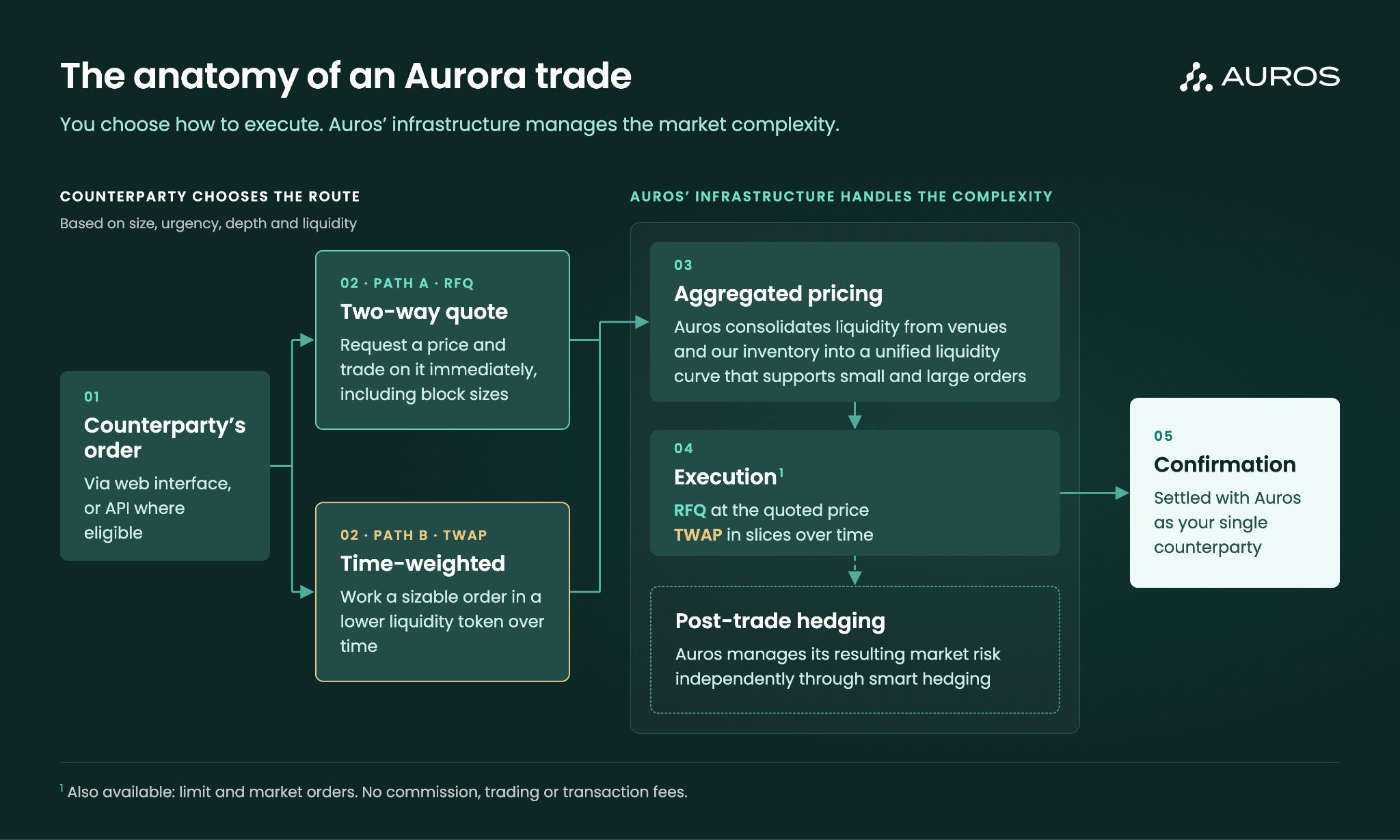
Aurora brings several execution methods into one workflow to address this. Counterparties can trade through request-for-quote (RFQ), place limit and market orders, or use time-weighted average price (TWAP) execution to work an order over time. More sophisticated execution algorithms are also part of Aurora’s development roadmap. Counterparties can trade through Aurora's web interface or, where eligible, connect programmatically via API, allowing Auros liquidity to be incorporated directly into automated trading workflows.
The appropriate route depends on the trade — size, urgency, available depth, and the liquidity profile of the asset all shape how an order should be handled. Aurora gives trading teams the ability to select an execution method while Auros’ pricing and execution infrastructure handles the underlying market complexity.
Liquidity, pricing and the long tail
The liquidity needed to complete a trade may be spread across centralised exchanges, decentralised venues, and other sources, with available depth and pricing shifting continuously between them. A quoted spread provides one reference point, but institutional execution ultimately comes down to the price at which the full order can be completed, and that gap between quote and fill is where execution quality is really won or lost.
Aurora’s pricing engine draws on liquidity across the venues where Auros trades, alongside its own inventory, to construct a consolidated price for counterparties with focus on delivering consistent quoting, uptime, and overall price and cost. Transactions are executed at the agreed price, without additional commission, trading, or transaction fees. Counterparties can also evaluate Auros’ available depth directly through Aurora, allowing pricing and liquidity to be assessed on screen before execution. This makes the relationship between price, liquidity, and order size visible before committing to a trade. Once an order is executed, Auros’ technology manages its resulting risk across the wider market, accounting for available liquidity, market impact and changing conditions.
That aggregation matters most as institutional activity extends beyond BTC and ETH into crypto tokens, DeFi assets, and other markets where liquidity is more dispersed, access can be less straightforward and where many venues impose lengthy listing processes before a new token becomes tradeable at all. Aurora supports major digital assets alongside a broad range of altcoins and DeFi tokens, and new tokens can be added upon request, subject to Auros’ internal review. For institutions trading beyond the largest assets, this provides a way to access both major and longer-tail markets through the same trading desk.
One counterparty, one relationship
Sourcing liquidity across multiple venues is only half the challenge. Institutions trading across a fragmented market also have to manage a fragmented set of counterparty relationships, each with its own credit terms, settlement process and operational overhead.
Removing this complexity, Aurora is designed to allow eligible counterparties to execute directly with Auros as their counterparty, while Auros handles how liquidity is sourced and deployed across its wider trading network. A counterparty does not need to establish and manage separate trading relationships with every underlying venue that may contribute liquidity to a trade.
The same relationship carries through to settlement, where Aurora can support different arrangements depending on the counterparty’s requirements, including intraday deferred settlement, subject to agreed settlement and risk parameters.
Access follows the institutional standard: onboarding for eligible counterparties involves completion of necessary KYC/AML and related compliance checks, execution of relevant trading documentation, acceptance of Aurora’s terms and conditions, and completing the technical setup. From there, electronic execution is backed by Auros’ 24/7 global coverage across the Americas, EMEA and APAC, with high-touch support and bespoke execution structures available for larger or more complex trades. Underneath it all, security is built in — two-factor authentication, role-based permissions and controls covering access management, encryption and position monitoring — so the same relationship that simplifies execution doesn’t come at the cost of control.
The desk built for how institutions actually trade
Institutional OTC execution today is as much about the infrastructure around a trade — liquidity aggregation, pricing, execution methods, settlement — as the trade itself.
Aurora brings that infrastructure together with Auros’ global trading desk, so institutions can request a price, place an order, run an execution algorithm, or work directly with a trader depending on what the trade actually needs.
One counterparty. Every market. Best venue pricing.
To find out more about Aurora, contact us.
Disclaimer
The material provided in this document is for informational purposes only and is intended only for institutional or professional counterparties. This document does not constitute, or is intended to, or shall be construed as or deemed to, constitute (i) any legal, financial, investment, tax or trading advice to, or an offer or commitment or a solicitation to, enter into or conclude any transactions, including any sale or purchase of any digital assets, or any form of financial instruments referencing digital assets, or (ii) an offer or commitment to provide any services or products by Auros in any jurisdiction, in each case, where such an advice, offer, commitment, solicitation or provision would be illegal. This document is not directed at, nor intended for distribution to or use by, any person residing or located in any country or jurisdiction where such distribution or use would be illegal or contrary to local laws and regulations.
The contents of this document are provided "as is" and without representations and warranties of any kind either express or implied, including without limitation the factual information obtained from publicly available sources. Auros and its affiliates (and each of their respective employees, shareholders, directors, officers and representatives) is not liable whatsoever for any indirect, special, consequential or punitive damages, or for any costs, expenses, losses, damages or liabilities (direct or consequential) arising from the use or reliance of any content in this document, or the applicability of this document for the specific purposes and objectives of the recipient. You are advised to conduct your own research and seek independent legal, financial, investment or other professional advice. Neither this document or any copy thereof may be taken, reproduced, redistributed, directly or indirectly, without the prior written consent of Auros.
Aurora is only available to “professional investors” as prescribed under Section 1 of Part 1 of Schedule 1 to the Securities and Futures Ordinance (Cap. 571 of the laws of Hong Kong) or to persons of such equivalent status under laws applicable to such person. Access and use of Aurora shall be subject to the Aurora Terms and Conditions.