Security Beyond Smart Contracts: What Protocols Need to Know to Attract Long-Term Liquidity
As DeFi’s attack surface expands beyond smart contracts, liquidity providers are increasingly evaluating protocol resilience against its broader operating environment, from governance structures and operational controls to multi-chain architecture and infrastructure dependencies. Drawing on Auros’ experience as a market maker, this article examines how - beyond the code itself - governance, infrastructure and operational controls are becoming critical factors in modern DeFi security. It also outlines the key considerations protocols should heed as resilience becomes a differentiator in attracting long-term liquidity.

Resilience is becoming a prerequisite for liquidity, and protocol security now extends far beyond the code itself
For much of DeFi’s history, security discussions revolved around smart contracts.
The industry’s response was clear: invest heavily in audits, formal verification, and bug bounty programmes to strengthen the code layer and reduce exploit risk.
Those efforts have made DeFi considerably more resilient, but they have not eliminated risk. Instead, the attack surface has shifted. As smart contracts became more resilient, attackers have moved up the stack, targeting infrastructure, governance permissions, signing workflows, and operational processes surrounding protocols. Many of today’s most consequential incidents stem not from flaws in the code itself, but from weaknesses in the systems that support it.
For protocols seeking to attract long-term liquidity, this shift matters.
Today, liquidity providers evaluate more than just smart contract audits. As a market maker deploying liquidity across multiple venues, chains, and protocols simultaneously, Auros has seen how operational resilience ultimately shapes liquidity decisions. While audits remain an important indicator, they rarely provide a complete picture of how a protocol will behave under operational stress.
The Attack Surface Has Expanded
Security is no longer confined to smart contracts.
Over the past few years, the industry’s threat landscape has expanded to include validator infrastructure, cloud environments, bridges, governance permissions, oracle networks, and transaction-signing workflows. Earlier cycles were defined by smart contract vulnerabilities and protocol design flaws, exemplified by incidents such as the US$190 million Nomad bridge exploit and the US$110 million Mango Markets attack. As code-layer security matured, attackers increasingly shifted their focus towards the infrastructure and operational systems surrounding protocols. In several recent high-profile incidents, the underlying contracts functioned as intended while failures emerged elsewhere in the system.
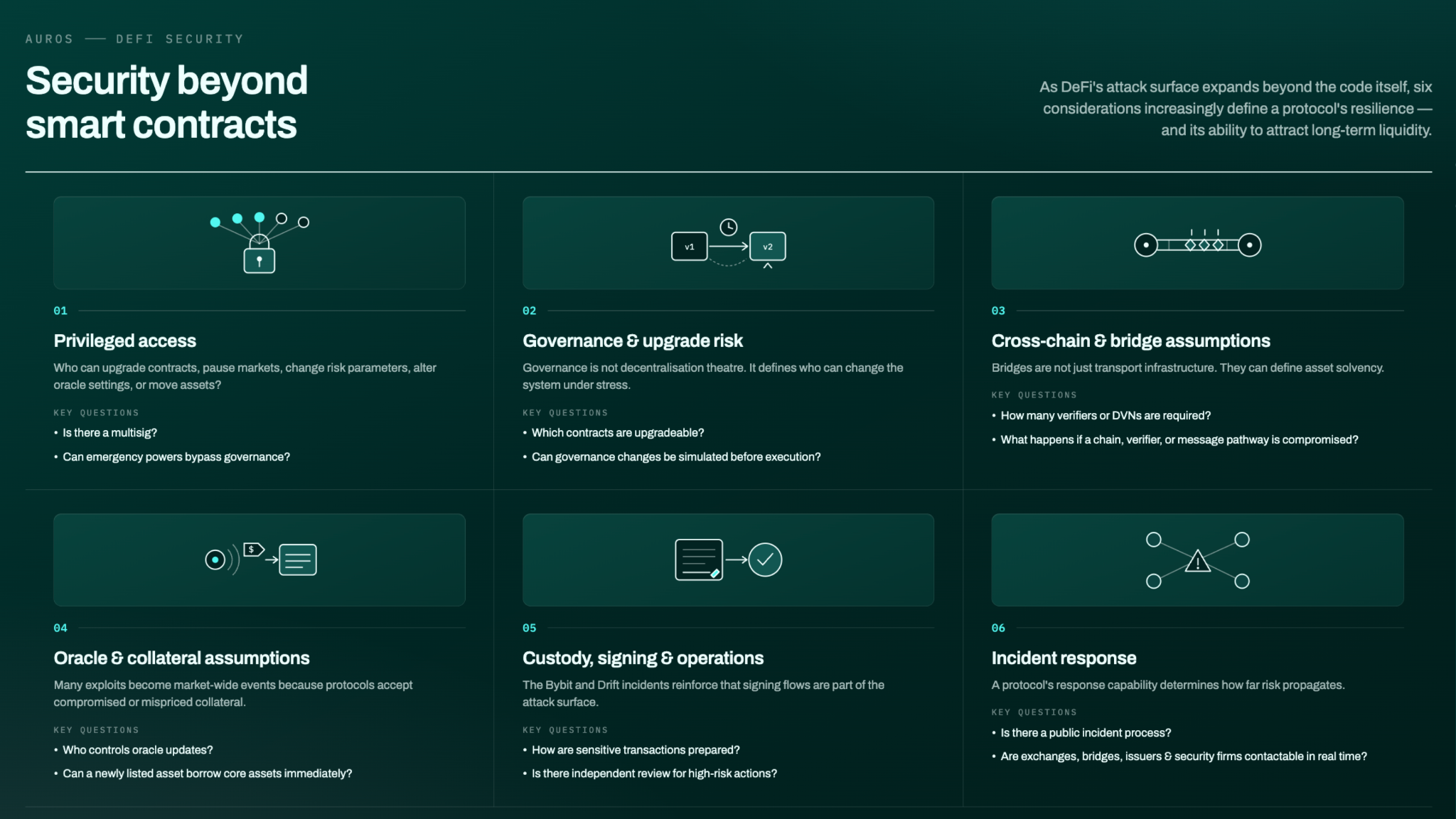
This reflects a broader reality: protocol security is now shaped by the interplay of technical, operational, and governance controls. A protocol may have thoroughly audited contracts, but vulnerabilities in critical dependencies can still create significant market consequences. From Auros’ perspective, protocol resilience comes down to a handful of critical considerations: who controls privileged permissions, how upgrades and emergency actions are governed, what infrastructure and third-party dependencies the protocol relies upon, and how quickly risks can be contained when issues emerge.
For liquidity providers interacting with DeFi infrastructure, the distinction between protocol risk and operational risk is increasingly blurred. If the systems responsible for governance, execution, validation, or settlement fail, the market impact can be similar regardless of where the vulnerability originated. These questions often reveal more about a protocol’s ability to withstand stress than audits alone, particularly as liquidity, assets, and users move across an interconnected multi-chain environment.
Sustaining participation is now contingent on a protocol’s ability to recognise security as a system-wide responsibility rather than a single technical function.
Liquidity Providers Manage More Than Liquidity
Rather than interacting with a single protocol, market makers often operate across dozens of venues, ecosystems, and infrastructure providers simultaneously. Liquidity providers may depend on multiple protocols, bridges, custodians, oracle networks, exchanges, and settlement systems functioning as expected.
This interconnectedness creates a unique perspective on risk.
When a protocol experiences an operational failure, the consequences rarely remain isolated to that protocol alone. Liquidity can withdraw rapidly, spreads may widen, trading activity can deteriorate, and market confidence can weaken. The financial impact often propagates across participants connected to that ecosystem.
From a liquidity provider’s perspective, security incidents are therefore not simply technical events. They are market structure events. In practice, market makers are often among the first participants required to assess whether liquidity deployment, inventory management, or risk parameters should change following an incident.
The source of an incident is often less important than its ability to disrupt liquidity, settlement, collateral quality, or market confidence. Whether a failure originates from a smart contract vulnerability, compromised signing process, bridge dependency, or governance error, the resulting market impact can be remarkably similar.
This is why operational resilience forms part of the due diligence process for market makers and why it should matter to protocols seeking to attract institutional liquidity. For protocols, this cuts both ways. Protocols compete not only for retail users but for the professional liquidity providers and market makers who make their markets function - deep liquidity, tight spreads, and reliable pricing are what draw retail activity in turn. Demonstrating strong governance and operational resilience is what earns that professional liquidity's trust, making security one of the clearest levers a protocol has for attracting both institutional capital and the users who follow it.
Before deploying capital, providers need confidence that a protocol understands its critical risks and has mechanisms to manage them. They want clarity on decision-making, dependency management, and crisis response. For protocols, this is more than a risk management test. Professional market makers select where to deploy capital, integrate infrastructure, and commit long-term resources and operational maturity is an important factor in this decision-making process.
It must be said that strong operational controls do not eliminate risk. They reduce the probability that a localised issue becomes a market-wide event. Clear governance structures and incident-response processes can further strengthen trust in a protocol over time.
What Modern DeFi Security Looks Like
As the threat landscape evolves, security frameworks must evolve alongside it. Smart contract audits remain essential, but more often than not, they represent the starting point rather than the finish line. When evaluating new protocols, Auros assesses how risk is governed across the broader system rather than focusing solely on smart contract audits. This includes who controls privileged permissions, how upgrades and emergency actions are managed, and whether safeguards such as multisigs, signer independence, and timelocks are in place.
"When we assess a protocol's liquidity needs, we're really assessing everything that could compromise that liquidity: how upgrades and upgrade keys are managed, how vulnerable the protocol is to bridge or oracle dependencies, and how operationally resilient it is when something breaks. Protocols that want deep, reliable liquidity must first make themselves deeply trusted and reliable to liquidity providers." - William Meng, Senior DeFi Trader, Auros
Similar scrutiny applies to oracle design, collateral frameworks, and risk controls, where isolated weaknesses can quickly become market-wide events. Moreover, incident response capabilities often determine how effectively risk can be contained when issues arise.
Together, these factors provide a more complete picture of a protocol’s resilience and increasingly shape how liquidity providers evaluate long-term participation.
Building Confidence Beyond Code
The DeFi industry has spent years strengthening smart contract security. As liquidity becomes more fluid across chains and ecosystems, the next phase of maturity will be defined by the resilience of the systems surrounding it. Through deploying liquidity across diverse market environments, Auros has observed that resilience is rapidly becoming a prerequisite for liquidity, with protocols that can demonstrate strong governance, operational discipline, and risk management often being better positioned to attract participation across market cycles. As competition for liquidity intensifies, resilience is emerging as a differentiator in its own right.
.png)

.png)